

Managing finances wisely is a crucial aspect of our daily life. Be it purchasing a house, a personal loan, mutual funds, retirement planning, or calculating the interest on your savings, making the right financial decision can help you achieve your financial goals. However, calculating the amount needed to invest, pay back a loan or mortgage, or the interest earned and paid can be challenging.
That’s where financial calculators come in handy. Financial calculators help individuals, families, or businessmen to know the amount to be spent on a particular item or invest in the market.
We at CostCalco bring to you some exciting online calculators that make everyday calculations easy and hassle-free. So, let’s dive right in and discuss the different types of financial calculator and their benefits.
What are financial calculators?
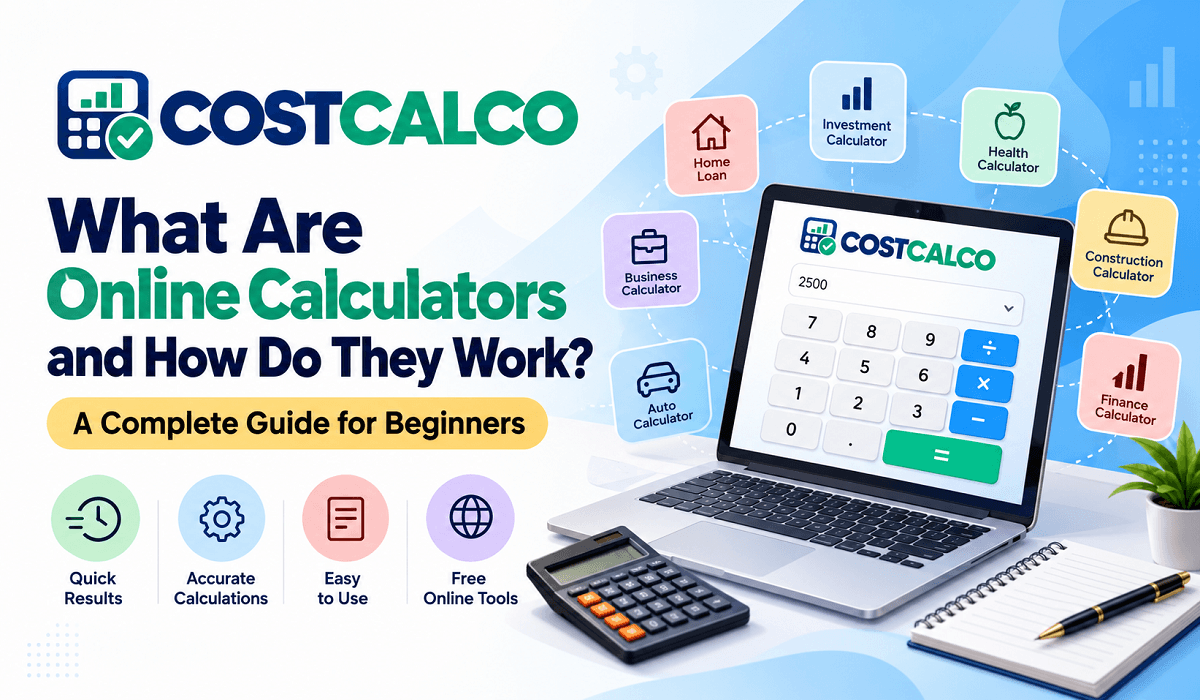
Financial calculators are online tools that perform calculations related to currency exchange, interest, loans, income, and any other monetary figures. Anyone needing to calculate a small number or solve a complex mathematical problem uses a financial calculator. All you need to do is enter the required figures, and the tool will do the calculation and give you the result.
For instance, you can use a loan calculator to know how much you owe monthly or yearly. Similarly, you can use a retirement calculator to estimate how much money you will have after retirement.
Financial calculator help people make informed decisions and ensure that they are financially stable in the long run. Moreover, people can compare the offers and choose the best option available to them. Here are some of the tools:
1. Loan calculator: Get to know how much you have to pay monthly
Taking a loan is a significant decision, and people must assess whether they can afford to pay the equated monthly instalment (EMI). You can use a loan calculator to know the EMI, the interest you owe, and the total amount you need to pay back. You can also use it to compare which loan tenure is more suitable for you.
A loan calculator works by taking the loan amount, the rate of interest, and the time you need to repay the loan. With this data, it estimates your monthly or yearly payment. The formula for calculating the EMI is:
EMI = P × r × (1 + r)^n ÷ [(1 + r)^n − 1]
In this formula,
P is the amount of the loan,
r is the rate of interest (in decimals),
n is the number of monthly payments.
For example, if you take a loan of ₹5,00,000 at 10% interest for 5 years, your monthly payment will be approximately ₹10,624. Using an online calculator, you can also know your monthly payment, the total interest you need to pay, and the total amount you will owe.
2. Mortgage calculator: Know how much you owe while buying a house
Purchasing a house is one of the most significant financial decisions. Using a mortgage calculator, one can know the amount that needs to be paid monthly after buying the house.
A mortgage calculator typically asks for the value of the property, the amount of the down payment, the mortgage or loan amount, the rate of interest, and the number of years to repay the loan. It can also ask for the property taxes and insurance, if any.
Let’s say you want to buy a house worth $ 60,00,000. Using a mortgage calculator, you can know how much you have to pay depending on the down payment, the loan amount, the rate of interest, and the years to repay the loan. You can also get an estimate of the housing costs and create a realistic budget.
Using a mortgage calculator tool before taking the home loan will help you compare the offers and ensure that you can afford the property. It is always advisable to make realistic assumptions and calculate the amounts based on those figures before submitting the application form. Note that some additional costs like processing fees, insurance, and other charges must be considered when calculating the monthly payment.
3. SIP calculator: Know your estimated returns on investment
A Systematic Investment Plan (SIP) allows an investor to invest a certain amount in a chosen fund on a regular basis, usually monthly. SIP calculator helps an individual know the amount he will have to invest every month to meet his retirement savings goal.
The SIP calculator tool uses the monthly investment amount, rate of interest, and the term of the investment to give you the value of your investment at the end of the term. It also helps you know how much you need to invest every month to meet your retirement savings or other financial goals. For example, if someone wants to invest ₹5,000 monthly for 20 years, the future value of this investment will be approximately ₹49.5 lakh, assuming a 12% rate of interest. Please note that this is just an example, and the actual amount will depend on the rate of interest. You can also use this tool to compare the estimated value of your investment with varying terms and monthly investments.
4. Retirement calculator: Plan for your post-work life
Retirement planning is one of the crucial financial decisions as it involves a significant amount of money. Using a retirement calculator, you can estimate the amount you will need for your retirement and how much you have to invest today to meet this goal. In addition, it also helps you compare the returns on investment options and understand how much additional income you will need to supplement your retirement.
One of the critical factors in retirement planning is inflation. Inflation eats into your savings, and you may find that the amount you have accumulated for your retirement will not be sufficient. For instance, if you currently spend ₹40,000 a month on your maintenance, you will need an amount that can sustain you at least ₹1.28 lakh per month if you retire in 20 years, considering an annual inflation rate of 6%.
Using the retirement calculator tool, you can also know how much you have to save monthly to meet your post-work savings goal. Moreover, you can also estimate how much you will have to spend if you retire at a later date. Remember that you will also have to account for healthcare expenses, income tax, and other expenses while calculating your retirement needs.
5. Interest calculator: Know the interest on your savings or the interest you will have to pay on a loan
Interest is a significant part of our financial system. Almost all financial contracts – credits, deposits, and insurance policies- involve some form of interest. The interest rates are usually expressed in percentages (%). Using an interest calculator, you can determine how much interest you will be charged for a loan or how much interest you will earn on your savings.
There are two types of interest: simple and compound interest. Simple interest is calculated only on the principal amount. In contrast, compound interest is calculated using the principal amount and the interest accumulated over a specific period. Let’s look at the formula for simple and compound interest:
Simple interest = (P × R × T)/100
A = P(1 + r/n)^(nt)
In these formulas,
P = principal amount
R = rate of interest
T = time in years
r = rate of interest (in decimals)
n = number of times the interest is compounded per year
t = number of years
So, if you want to know how much interest you will earn on ₹1,00,000 at 8% for 5 years, the simple interest calculator will give you ₹40,000. On the other hand, a compound interest calculator, assuming the interest is compounded annually, will give a future value of ₹1,46,933. Therefore, you will earn ₹46,933 as interest.
Interest calculators help you know how much interest you will be charged on a credit or loan or how much you will earn on your fixed deposit or your savings. They also help you compare the interest offered by banks. Moreover, it also helps you know how much you will have to invest or save today to meet a future financial goal.
What are the benefits of using an online financial calculator?
Financial calculators make monetary calculations easy and fast.
They help you plan your budget and make informed decisions related to your money. In addition, since you can compare different offers, you can make the best financial decision.
Why choose CostCalco’s financial calculator tools?
Choosing the best financial calculator tool depends on your needs. So, if you want to take a personal loan, you may use a loan calculator. If you plan to buy a house, you may use a mortgage calculator. If you want to invest in mutual funds, an SIP calculator will help you know how much you need to invest monthly to achieve your financial goals. A retirement calculator, on the other hand, will help you know how much you will need for your retirement. Similarly, you can use an interest calculator to know how much interest you will be charged on a loan or how much interest you will earn on a fixed deposit.
Before using any of these tools, make sure to know their assumptions and limitations. For instance, some calculators assume that the rate of interest is annual while others assume it to be monthly. Some also assume that there are no taxes or inflation, while some consider them. In case of a significant financial decision, it is advisable to consult a professional financial advisor.
Conclusion
Financial calculator help people with their day-to-day financial decisions. They help people calculate how much they owe or need to pay back and how much they will have in the future. You can use the online financial calculator tools to make better financial decisions and achieve your financial goals.
Whether you plan to take a personal loan, a mortgage, or invest in mutual funds, an online financial calculator tool will help you make the best decision.
Check out the different calculators at CostCalco and start making the best monetary decisions today. Keep in mind that the result given by the calculator is an estimate based on the assumptions given. Moreover, it does not guarantee future performance.
Frequently Asked Questions (FAQs):
1. What is a financial calculator?
A financial calculator is an online tool that helps people calculate loan instalments, interest, investments, mortgage payments, and retirement savings.
2. Are online financial calculators free?
Most online financial calculators are free to use. You can use CostCalco’s free online financial calculators to make simple calculations.
3. How does a financial calculator work?
A financial calculator is used for various purposes. It uses a specific formula to calculate monetary figures based on the data given by the user.
4. What is the difference between a loan calculator and a mortgage calculator?
A loan calculator is used to calculate the instalments for different types of loans, whereas a mortgage calculator is used to calculate the monthly instalment for a home loan.
5. How does an SIP calculator work?
An SIP calculator works by using monthly investment, the rate of interest, and the term of the investment to determine the future value of the investment.
6. How accurate is the SIP calculator?
An SIP calculator is just an estimate. The mutual fund’s future value depends on its performance, and it can be volatile. Therefore, the future value given by the SIP calculator is not guaranteed.
7. How much should I invest monthly for my retirement?
The amount you need to invest monthly depends on your retirement age, current age, inflation, future expenses, and the rate of interest. You can use the retirement calculator to know the amount you need to invest monthly to meet your retirement-related financial goals.
8. What is the difference between simple and compound interest?
Simple interest is calculated only on the principal, whereas compound interest is calculated on the principal and the interest for the previous period.
9. Can a financial calculator help me save money?
Yes, financial calculators help you compare different financial options and help you decide which option is the most beneficial.
10. Do financial calculators consider inflation and taxes?
It depends on the calculator. Some calculators consider inflation and taxes, while others do not. Always make sure to read the terms and conditions before you use any financial calculator.