
Running a successful business entails more than just raking in profits. Business owners must have an understanding of the figures for profitability, operating expenses, investment, and risk in order to make sound decisions. Whether you are a start-up owner, freelancer, accountant, business manager, small-scale proprietor, or an established corporation, financial calculations will always affect your day-to-day operations and contribute to your plans for expansion and growth.
Business calculators come in handy to make calculations on profit margins, operating expenses, ROI, break-even point, and other essential aspects of running a business. Anyone who handles finances on a regular basis, from entrepreneurs to accountants, can benefit from a business calculator.
At CostCalco, we have an online platform that hosts different calculators that simplify your daily calculations in business and beyond. And, in this guide, we will go through the basic yet essential business calculators and demonstrate how exactly they can improve your financial management and help in arriving at more informed decisions.
What Are Business Calculators?
Business calculators usually refer to a category of calculators that perform calculations on various business-related metrics like profit margin, ROI, break-even point, operating expenses, and several others. A business calculator can calculate anything from profit margin to operating expenses.
Most of these calculators are digital tools available via online hosting or downloadable files. The user simply has to input the necessary values, and the tool does the calculation within seconds. Various people benefit from the use of business calculators, such as small business owners, entrepreneurs, sole proprietors, accountants, and financial managers.
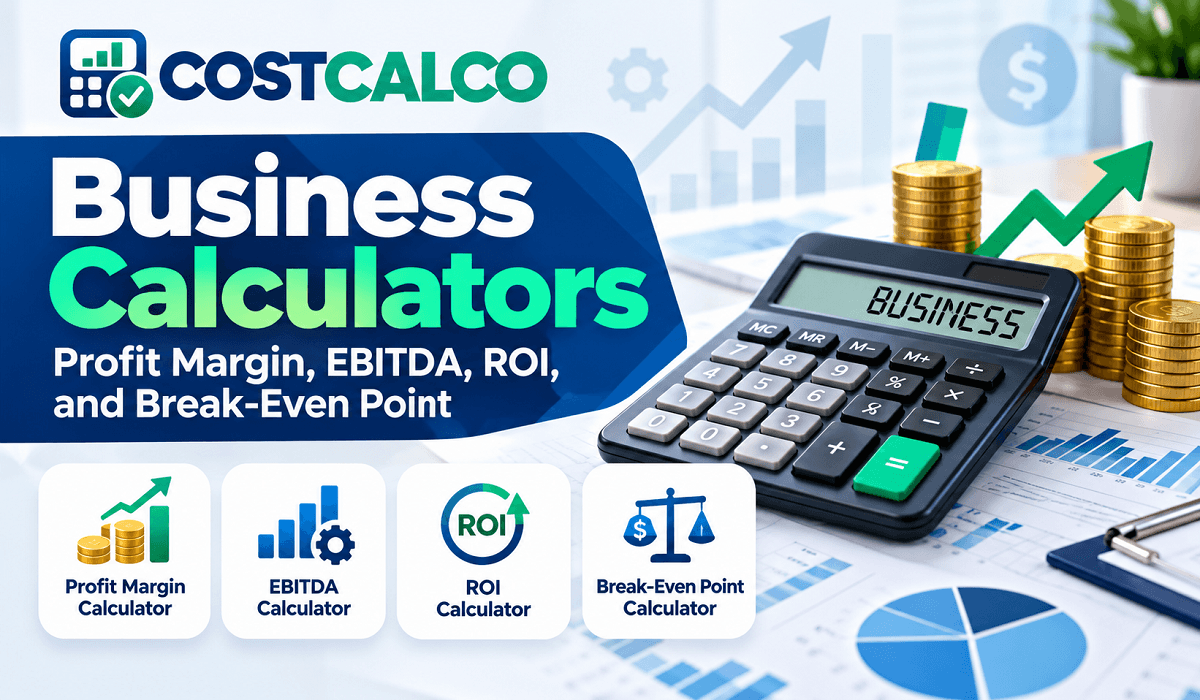
There are different types of business calculators; however, we will be discussing the four most crucial business calculators that play a very significant role whenever one is managing a business or a start-up.
1. Profit Margin Calculator: Your Guide to a Successful Bottom Line
As an entrepreneur, you must always be calculating numbers, whether related to day-to-day operations or predicting future trends. In this regard, a profit margin calculator is a great tool to determine what you earned against what you spent. Profit margin is expressed as a percentage and shows the ratio of a company’s profit to its total revenue.
One could be making huge profits from sales; however, if your expenses exceed some of these profits, you might still be in the red. A profit margin calculator indicates the percentage of revenue that the business earned for every unit of currency of goods sold. The profit margin calculation involves taking the gross revenue that the business earned and dividing it by the profit earned from sales.
Using the Profit Margin Calculator
A profit margin calculation is done using the formula below:
Profit Margin (%) = (Profit ÷ Revenue) × 100
For instance, say an online clothing store makes a revenue of ₹ 5,00,000 and books a profit of ₹ 1,00,000. The profit margin is calculated as:
Profit margin = (₹ 1,00,000 ÷ ₹ 5,00,000) × 100 = 20%
Thus, for every ₹ 100 of revenue earned, there is a profit of ₹ 20 in the given clothing store, according to the given numbers.
Different companies have varying ways of calculating profit margins depending on the expenses that they consider. Normally, a distinction is made between gross profit, operating profit, and net profit. Gross profit is calculated by subtracting the cost of goods sold from total revenue.
Benefits of Using a Profit Margin Calculator
A profit margin calculator is crucial since it will help an entrepreneur compare products and services, as well as analyze and forecast future performance. With this calculator, one can easily assess whether they are selling products at the right price or whether their costs are too high. A profit calculator helps evaluate the performance of products or services and determine which ones to invest in. Entrepreneurs may utilize these calculators to estimate their expected profit percentage, forecasting revenues for products or services.
2. EBITDA Calculator: Gauge Business Performance
EBITDA stands for Earnings Before Interest, Taxes, Depreciation, and Amortization. EBITDA helps measure the performance of a business, and it is mainly used when comparing similar companies. It works by removing the effect of different capital structures, and it provides a clear picture of a company’s performance, irrespective of the tax, interest, and amortization costs it might have incurred.
However, EBITDA does not necessarily portray a company’s total income. It might also miss out on crucial figures concerning the operating budget. Nevertheless, it is a crucial metric that should be evaluated alongside other financial figures.
How to Calculate EBITDA?
There are different ways to calculate EBITDA depending on the figures available. The most common formula is obtained from a company’s income statement:
EBITDA = Net Income + Interest + Taxes + Depreciation + Amortization
Consider a company that reports the following figures:
Net income: ₹ 8,00,000
Interest: ₹ 1,00,000
Taxes: ₹ 2,00,000
Depreciation: ₹ 50,000
Amortization: ₹ 25,000
From the above figures, EBITDA is determined as:
EBITDA = ₹ 8,00,000 + ₹ 1,00,000 + ₹ 2,00,000 + ₹ 50,000 + ₹ 25,000
= ₹ 11,75,000
The figures should ideally be generated from the same income statements for the same period to avoid deriving inaccurate results
Importance of an EBITDA Calculator
A business owner might use an EBITDA calculator to ascertain an increase or decrease in a company’s performance over a given period under consideration. An EBITDA calculator might also provide a fair comparison between different companies in comparable industries. This metric is essential for valuating and analyzing the operating performance of a firm, considering it is a mixture of costs incurred without adjustments for depreciation, amortization expenses, interest, and taxes.
Other than using an EBITDA calculator, it is also crucial to consider debt, capital expenditures, working capital, and cash before one can make fair financial statements.
3. ROI Calculator: Track Your Return on Investment
The return on investment (ROI) measures the overall return from an investment undertaking as a percentage. It is very essential to measure ROI in business analysis, as it enables an entrepreneur to determine whether investing in a given initiative will overyield or underyield. It enables one to compare various investment options against each other and helps in decision-making processes. It is always crucial to keep track of marketing budgets, investments, and spending in business to ensure that one can have an efficient overview of the financial status of their business.
Using the ROI Calculator
Return on investment (ROI) is calculated by dividing the total sum of gains earned from an investment by the cost of the investment and then multiplying it by 100. ROI is usually computed as:
ROI (%) = [(Investment gain – Investment cost ) ÷ Investment cost] × 100
Assuming a company spends money on a given investment, for instance, a marketing campaign. Say this investment generates an investment gain worth ₹ 80,000, while its investment cost is worth ₹ 50,000.
Thus, ROI will be [(80,000 – 50,000) ÷ 50,000] × 100
= (30,000 ÷ 50,000) × 100 = ₹ 60%
That is to say, the investment yielded a profit equal to 60% of the cost of investment. Nevertheless, it is also crucial to understand the figures that have been used when calculating ROI.
It goes without saying that a company’s gross revenue should not be used for ROI calculations. When calculating ROI, be it for a product or service, it should clearly indicate the cost of revenue and the gains earned from it. This enables the elimination of errors committed due to miscalculations of ROI.
Importance of Using ROI Calculators
An ROI calculator can be very handy in comparing the performance of two or more campaigns and initiatives. It also helps analyze investments that seem to be yielding or not. It is very easy to compare marketing budgets and campaigns and know whether switching to a new budget option may be more profitable than sticking with the current one. In other words, an ROI calculator is critical in enabling one to compare investments and make informed decisions. As a company grows, it is always important to monitor the yield from investments in diverse business areas in order to make wise judgments regarding the most profitable business plans.
4. Break-Even Calculator: Determine Sales Level
The break-even calculator estimates the break-even sales amount, which is the sales volume figure where total revenue is equal to total costs, resulting in neither profit nor loss. Start-up businesses and existing organizations need to determine projected break-even points before initiating new projects, services, products, and business locations. In a similar way, an understanding of break-even levels assists existing companies to determine the unit sales volume required to justify continued operations within a given business plan.
It is, therefore, critical for any entrepreneur to understand the break-even level in order to make wise decisions before setting up a start-up or an existing company. A break-even calculator is primarily concerned with analyzing the unit volume, while a Break-even formula for sales dollars calculates revenue in monetary figures.
Using the Break-Even Calculator
A Break-even calculator for a typical business scenario (not applying income tax) is:
Break-even point (units) = Fixed costs ÷ (Selling price per unit – Variable costs per unit)
Fixed costs refer to fixed charges that cannot be avoided within a given operating range and which generally include depreciation, rent, and payroll. On the other hand, variable costs are the costs incurred by a company depending on the volume of production, for instance, direct material and per-unit packaging costs.
Assume you run a restaurant and you have the following costs:
Monthly fixed costs = ₹1,00,000
Food and ingredient costs per unit = ₹300
Beverage costs per unit = ₹100, and the selling price per unit is worth ₹500.
Contribution per unit = ₹500 – (₹300 + ₹100) = ₹200
Break-even point = ₹1,00,000 ÷ ₹200 = 500 = 500 units
This implies that you need to sell 500 meals monthly without having any contribution profit for you, and your costs would be exactly equal to your total revenue. Thus, your restaurant incurs a loss of ₹1,00,000 monthly should you not reach that target volume.
It is paramount that break-even point calculators are always used in accordance with assumptions, and projections are evaluated in the light of real-world figures since the latter may involve variable costs and fixed costs, which are affected in different ways by various variables as well.
Importance of a Break-Even Point Calculator
Break-even point calculators are vital since they assist you in determining your sales level targets. They can also help you evaluate how increases in fixed costs may impact break-even volumes as well as how your break-even point will be affected in case of changes in prices per unit you sell.
How to Pick the Right Business Calculator?
The choice of a business calculator will always depend on what an individual or company specifically wants, and the following table shows the key business questions against appropriate calculator options:
The Business Question
Recommended Calculator
How am I performing? (Is my business profitable?)
Profit margin calculator
What are my earnings before particular expenses?
EBITDA calculator
How is my investment performing?
ROI calculator
What is the sales level I need to obtain in order to be at zero profit?
Break-even calculator
Therefore, in order to achieve desirable results, it is essential that one applies a combination of the above-mentioned financial calculators, bearing in mind that an effective mixture of financial calculations aids in supporting and facilitating informed business decisions. For example, having a high profit margin does not necessarily guarantee that an entrepreneur can sustain cash flow and profits in the future. Moreover, an investment might have an attractive ROI, although its cash flow projections might signify that an entrepreneur might not be able to recoup costs within the time frame they expect. It is, therefore, critical that one takes keen measures when conducting all financial calculations, bearing in mind the relevance of information in making wise financial decisions.
Why Business Calculators Are Crucial
Using online calculators has significant advantages for small businesses as, well as corporations, especially when it comes to decision-making processes. Some advantages of using these calculators have been discussed below:
1. They save time: They help avoid lengthy calculations and manual computations.
2. They prevent mathematical errors: They also minimize calculation errors when the information provided is precise.
3. They help in projecting sales: This enables entrepreneurs and business owners to analyze investment options and make accurate financial plans and forecasts.
4. They also assist in simplifying financial terms and calculations: This promotes financial literacy among entrepreneurs and business owners.
In fact, Costcalo is a perfect platform to begin with if you like to simplify calculations and make wise financial decisions in your daily work life.
Conclusion
Business calculators play a significant role, in determining the success of a business plan, venture, or an organization. A profit margin calculator determines a company’s operating efficiency, an EBITDA calculator measures the operating performance, ROI calculates the investment yield, and a break-even calculator calculates the sales level. Therefore, as an entrepreneur, it becomes essential to utilize a mixture of profitability, investment, operating, and break-even calculators as opposed to evaluating an individual calculator in isolation. This will support your financial analysis and aid you in making informed financial decisions for your business. Remember to use accurate calculations when analyzing the figures, as they play a key role in influencing your decision-making process.