
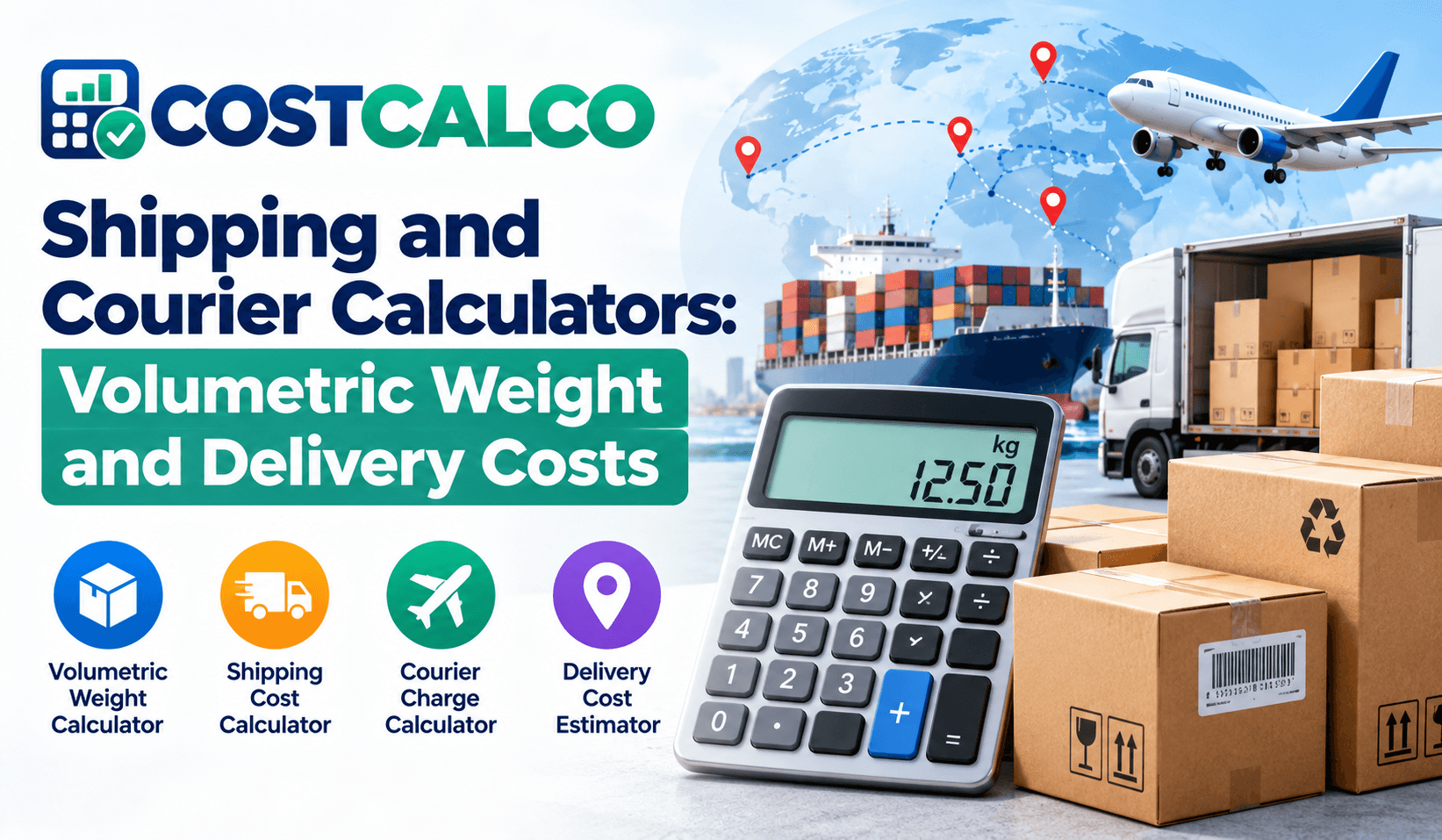
Knowing how much shipping costs can be key to running a successful e-commerce business, online shop, and courier service. Understanding how Shipping and Courier Calculators can ensure you save money by sending small items locally or heavy items worldwide.
While many believe courier charges are calculated based on actual weight, shipping companies also look at what space your parcel takes up. This is where a volumetric weight calculator or shipping cost calculator can help.
Using our online shipping tools, you can calculate your shipping costs, including volumetric weight and comparing package sizes.
In this guide, we will cover how to calculate volumetric weight, how courier companies calculate costs and how using an online shipping calculator can help both individuals and businesses save unnecessary costs.
What Is Volumetric Weight?
Volumetric weight (also known as dimensional weight) is used by courier companies to see how much space a package takes up.
Large light packages can take up a lot more room in a vehicle or plane. Therefore, many shipping companies will charge based on a packages volumetric weight.
For example a box full of pillows may only weigh 3kg, but take up much more space whilst a small box with metal parts can weigh 8kg but not take up much space.
This is why courier companies use volumetric weight.
Volumetric Weight Formula
The formula to calculate volumetric weight is:
Volumetric Weight = Length x Width x Height / Divisor
Make sure your package measurements are in centimetres.
Example:
Your package is 40cm x 30cm x 20cm. The courier is using a divisor of 5,000.
Volumetric Weight = 40 x 30 x 20 / 5,000
Volumetric Weight = 24,000 / 5,000
Volumetric Weight = 4.8kg
Your package’s volumetric weight is 4.8kg.
The divisor used may vary depending on the courier, type of service and type of shipping you are doing. Some services use a divisor of 4,000, 5,000 or 6,000 whilst some have different rules. To get the most accurate shipping cost, we recommend checking your carrier’s guidelines.
What Is Chargeable Weight?
The chargeable weight is the weight used to calculate your shipping costs. This is often calculated based on your packages actual weight and its volumetric weight.
It is often:
Chargeable Weight = Highest of (Actual Weight or Volumetric Weight).
For example:
Actual weight = 3kg
Package size = 40 x 30 x 20cm.
Divisor = 5,000.
Volumetric weight = 4.8kg.
As the volumetric weight is higher than actual weight, a chargeable weight of 4.8kg would usually be used.
However, if your courier rounds the chargeable weight up to the nearest full kilo, you may end up paying 5kg.
This is important as your chargeable weight can be affected by changing the size of your packaging.
How To Calculate Volumetric Weight
This tool will help you calculate the dimensional weight of your parcel.
To calculate your volumetric weight:
Measure your package. Measure the external size of the package once your product has been packaged.
Select the unit. Choose either centimetres or inches.
Put your measurements in. Enter your package measurements.
Pick your divisor. Select the divisor given by your courier.
Calculate. The tool will calculate your volumetric weight.
Compare. Compare your actual weight and your volumetric weight. The higher of the two will be used for an estimate of your chargeable weight.
To get the most accurate results, measure the size of your final packaged item. Adding extra padding, large boxes and protective packaging can impact the size of your package.
How Is Courier And Shipping Costs Calculated?
There are several factors to consider when calculating courier costs. We list them below to give you an idea of what can help you calculate how much your delivery will cost.
1. Actual & Volumetric Weight
The chargeable weight is often the main factor affecting your shipping costs. The heavier your parcel the more it can cost to deliver. Bulky parcels can also cost more.
2. Distance
The distance between the drop off and delivery can impact how much you pay. Deliveries within the same country may be cheaper compared to deliveries across the country or internationally.
3. Delivery Times
Fast delivery or same day deliveries can cost more. Consider what your customers expect and how it will affect your profit margins.
4. Size & Type Of Package
Large, fragile, oddly shaped or special handling packages can incur extra charges. Some couriers have size restrictions or special handling charges.
5. Extra Charges
You may be charged extra by your courier for:
Insurance/Declared Value
Cash On Delivery
- Delivery to remote areas
- Fuel Surcharge
- Customs Duty
- Delivery to Residential address/Special Handling
The exact charges will depend on the carrier, location, type of shipment and service.
How Can A Shipping Cost Calculator Help Businesses?
A shipping cost calculator can help you estimate how much your delivery will cost. This can be useful for online sellers, wholesalers, small businesses and logisticians.
Better Pricing Decisions
E-commerce businesses can use this tool to estimate their shipping costs. This can help them avoid undercharging their customers and help protect their profit margins.
Compare Courier Services
Different couriers can have different rates, divisors and delivery times. Using this tool can help you compare and find a suitable shipping option.
Save On Packaging Costs
This tool will show you how the size of your package can affect your chargeable weight. This can help you choose the right sized boxes.
Better Quotes
Freelancers, online sellers and small businesses can use this tool to estimate delivery costs. This will help reduce any surprises and can help you provide better quotes.
Control Your Shipping Costs
If you ship dozens or hundreds of packages a month, using a shipping calculator can help you predict how much your deliveries will cost. This can help you find ways to save.
Example
Let’s say you run an online shop and want to send your customer a product.
Your package details are:
- Actual weight = 2.5kg
- Length = 50cm
- Width = 30cm
- Height = 20cm
- Divisor = 5,000
- Rate = ₹100 per chargeable kg.
Calculate your volumetric weight:
(50 x 30 x 20) / 5,000 = 6kg.
Compare actual and volumetric weight:
Actual weight = 2.5kg
Volumetric weight = 6kg.
Chargeable weight = 6kg (before rounding).
Estimated shipping cost:
6 x ₹100 = ₹600.
Your estimated shipping cost is ₹600.
This is an example and is not a live quote. You may be charged extra for minimum weights, rounding, fuel surcharge, taxes and other charges.
Tips To Save On Shipping & Courier Costs
There are several ways you can control your delivery costs without impacting the safety of your products.
- Choose the right sized box. Don’t use oversized packaging as this will increase your volumetric weight.
- Lightweight packaging. Choose lightweight packaging to protect your items.
- Accurate measurements. Getting the measurements wrong can cause inaccurate estimates and extra charges.
- Compare your couriers. Compare prices, delivery times, coverage and extra charges.
- Negotiate rates. If you regularly ship you may be able to get a discounted rate.
- Bundle your shipments. If you can bundle eligible orders together you can reduce some costs.
- Check your shipping invoice. Compare the weight and size they have used to yours.
Why Use CostCalco?
Our online calculators can help you easily calculate your everyday calculations. By using our shipping or courier calculator you can easily estimate the cost associated with your parcel.
Whether you’re an online seller, small business owner or just sending a parcel, our online calculators can help you make better decisions.
Use our shipping tools to calculate your volumetric weight. Understand what your chargeable weight is and plan your delivery costs. To ensure you are getting accurate costs, use the latest rates and chargeable policies from your courier.
Conclusion – Shipping and Courier Calculators
Shipping and courier calculators can help you understand how much your package will cost to deliver based on the size, actual weight, distance and charges. Volumetric weight is very important as large packages can be more expensive to deliver due to their size.
By calculating your dimensional weight, comparing courier services, choosing the right packaging and considering extra charges, you can improve your shipping estimates.
CostCalco can make everyday calculations easier. Using our shipping calculators can help you estimate your costs and plan your budget. Use our shipping cost calculator to estimate your costs and confirm with your courier.
FAQs – Shipping and Courier Calculators
1. What is a shipping calculator?
A shipping calculator is an online tool used to calculate how much your delivery will cost. It will consider factors such as package weight, size, destination and shipping service. Depending on the tool, it may also take into consideration extra charges.
2. What is volumetric weight for couriers?
Volumetric weight is used to calculate how much space a parcel takes up. Courier companies use this to calculate how much shipping charges for bulky items.
3. How do you calculate volumetric weight?
Multiply your package dimensions and divide by your courier’s volumetric divisor. For example, a package measuring 40cm x 30cm x 20cm with a divisor of 5,000 will have a volumetric weight of 4.8kg.
4. What is the difference between actual weight and volumetric weight?
Actual weight is how much a package weighs in real life. Volumetric weight is calculated based on the size of your package.
5. What is chargeable weight for shipping?
Chargeable weight is the weight used to calculate your shipping costs. Many courier companies use this to calculate the chargeable weight by comparing the actual and volumetric weight. They will use the highest value.
6. Why is my volumetric weight higher?
Your volumetric weight can be higher if your package is large. This can often happen with items like pillows, clothes, cushions, lightweight furniture and other bulky items.
7. Do all couriers use the same volumetric divisor?
No. Each courier, service, shipping route and type of shipment will have different divisors. We always recommend checking your carrier’s current guidelines to calculate the chargeable weight of your parcel.
8. How can I save on my delivery costs?
Save on your delivery costs by using the right sized packaging, using lightweight packaging, comparing your couriers, negotiating volume discounts and avoiding any extra charges.
9. Are online shipping cost calculators accurate?
These calculators can give you a good estimate when you enter accurate measurements and current prices. However, you may not be charged exactly the same amount due to rounding, minimum weights, extra charges, taxes and other charges.
10. Can I use shipping calculators as a small business?
Yes. Small businesses can use shipping calculators to help them estimate their order fulfilment costs, set delivery costs, compare couriers, create quotes for customers and improve their profit margins.